
5 AI & SaaS Funding Myths Founders Still Believe in 2026

2 mins
Capital misconceptions could quietly sabotage your growth. The SaaS funding market is in the middle of a fundamental transition, one that's rewriting the rules founders built their strategies around.
The era of founder-friendly, liquidity-rich investment is over. In its place: a cautious landscape where investors have shifted from FOMO (Fear Of Missing Out) to what insiders call ‘forensic diligence.’ Global venture funding reached $425 billion in 2025 (up 30% year-over-year) yet the number of deals actually fell. Bigger bets, fewer recipients, and far more scrutiny.
The founders navigating this environment successfully aren't necessarily smarter. They've simply let go of the myths. Here are the five that are quietly holding the rest back.
Myth 1: “Everyone Needs This” Will Get You Funded
The Reality: Targeting expensive, painful problems for specific audiences is more fundable than universal appeals.
The idea that solving a universal problem guarantees a massive market is both wrong and pervasive. If everyone needs it, the question becomes: is it painful enough that anyone will actually pay for it?
In 2026, the market has shifted from solution-centric thinking to pain-centric investing. True value lies in addressing a specific, quantifiable, and expensive problem for a niche audience. Great product is no longer your key differentiator — a solid product-market fit is.
$2.00 spent in sales & marketing to acquire every $1 of new customer ARR — the median New CAC Ratio in 2024, up 14% year-over-year. — BenchmarkIt 2025 SaaS Performance Report
That stat tells you something important: the bar for justifying spend has risen sharply. The proliferation of cheap-to-build AI tools has lowered the barrier to entry, which has raised the bar for founders to identify and quantify a market's pain point before writing a single line of code.
Investors aren't looking for the biggest possible TAM. They're looking for the sharpest possible pain — one urgent enough that customers pull out their cards without a lengthy sales cycle.
“Show me the pain, not the promise.” That's the 2026 investor lens.
Myth 2: “You Need Venture Capital to Scale”
The Reality: VC is one path in an increasingly diverse funding ecosystem — not the only one.
The startup narrative has long been dominated by the ‘raise big or go home’ mentality. But 2025 data tells a more complicated story about who actually benefits from that playbook.
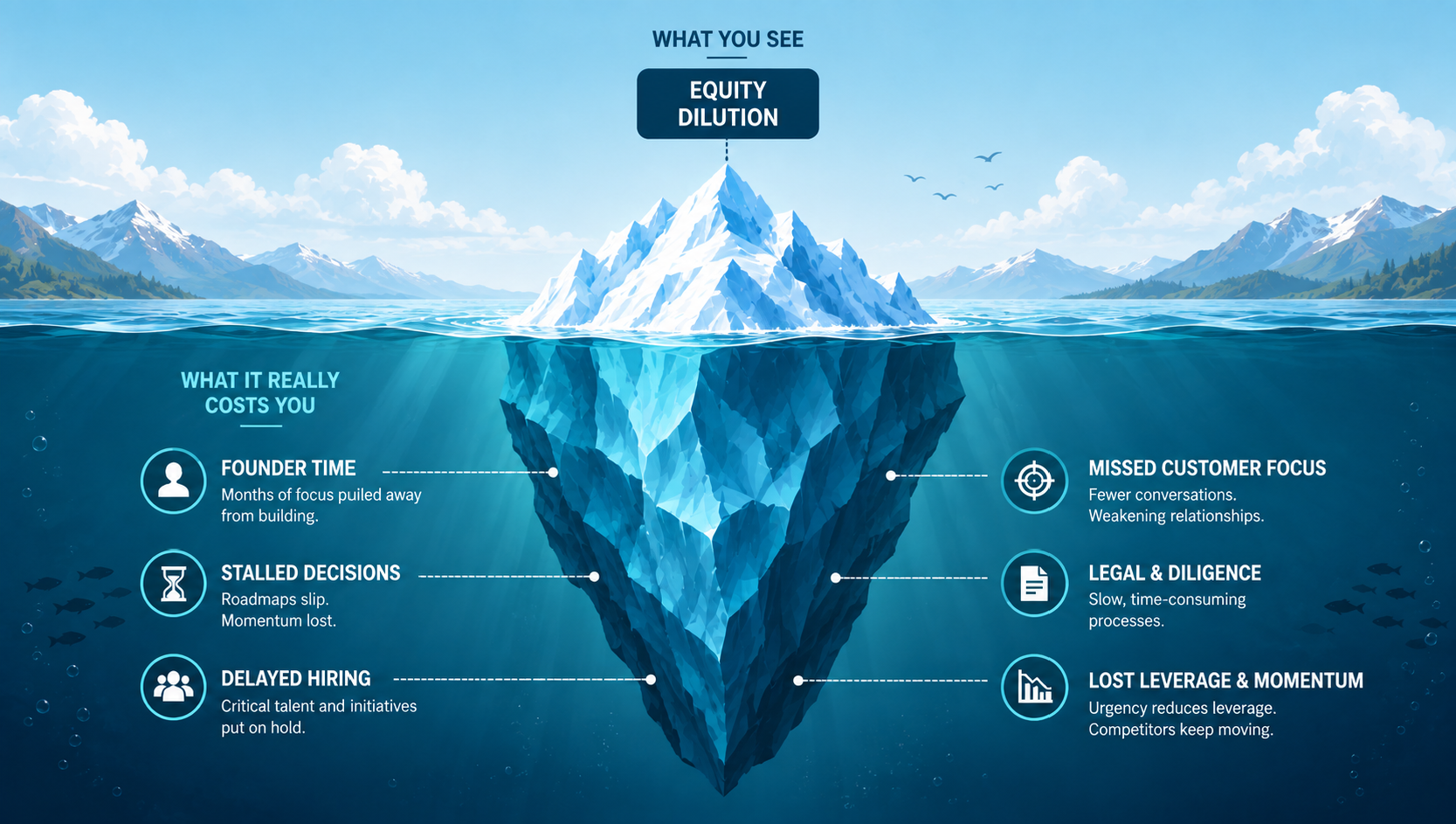
~50% of founders will lose ownership of half their company by the time they've completed a Seed + Series A round, factoring in option pools and round dilution. — Carta 2025 Dilution Benchmarks
Seed rounds now carry a median dilution of 19%. Series A adds another 18–20%. Stack in employee option pools at each stage and you can see why the math works against founders who raise aggressively early — each dollar of capital has a real long-term equity cost.
What's changed is that capital alternatives have matured enough to be genuinely competitive. Founders who treat VC as the only path are working with an outdated map.
Some options worth understanding in 2026:
- Non-dilutive growth capital — for companies with strong recurring revenue, this allows access to several million dollars tied to revenue performance, with no equity given up and no governance trade-offs. ECL, for instance, deploys up to $5M within 72 hours for qualified AI and SaaS companies.
- Venture debt — non-dilutive capital with structured repayment. Useful for extending runway, but watch for covenants that restrict operational flexibility.
- Government grants and R&D incentives — particularly material for India and Singapore-based founders, where innovation credits can be significant.
The smartest founders in 2026 treat their capital stack like a product decision: right tool for the right stage.
Myth 3: “Unicorn or Bust”
The Reality: Capital efficiency is the new fundraising superpower. The most fundable companies prove they don't need the money — they just want to accelerate.
For years, the dominant startup narrative was all-or-nothing: raise massive rounds, spend aggressively, chase the unicorn exit. That playbook burned through founder equity and investor patience alike.
In 2026, the market has re-centered around capital discipline. And the data backs it up starkly:
85% of bootstrapped SaaS companies are operating at or near breakeven — vs. only 46% of equity-backed companies. — SaaS Capital 2025 Spending Benchmarks Survey, 1,000+ companies
Median private SaaS growth has stabilized at 19–21% — down from the peak years, but steady. Companies that can sustain this kind of efficient growth are increasingly preferred to those burning faster for marginal gains.
The most fundable companies right now are those that can prove they do not need the capital to survive — only to accelerate. This is a profound shift. A startup that is nearly cash-positive and growing steadily is more attractive than one burning aggressively on unproven retention.
The metrics that now lead investor conversations: LTV:CAC ratio, CAC payback period, and net revenue retention. For context, median CAC payback has worsened to over 20 months for SaaS companies under $50M ARR — a sign that efficient acquisition now matters more than volume.
Operating with discipline is no longer a sign of limitation. It's a signal of fundability.
Myth 4: “AI Hype Will Get You Funded”
The Reality: In 2026, investors are applying a higher bar for defensibility. The technology is table stakes. The business model is the differentiator.
AI captured more than half of all global venture capital in 2025 — the first time in history that a single sector has exceeded 50% of total VC deal value.
52.7% of $512.6B in global VC deployed in 2025 went to AI and machine learning startups — the first year AI has captured the majority of global venture investment. — BestBrokers / PitchBook, CB Insights, LIQUiDITY analysis, 2025
But a critical nuance is hiding inside that headline number: the concentration is extreme. OpenAI's $40B raise alone accounted for a third of global Q1 2025 venture funding. Five companies — OpenAI, Scale AI, Anthropic, Project Prometheus, and xAI — collectively raised $84B, or 20% of all 2025 venture capital.
Meanwhile, the MIT Media Lab's July 2025 report — ‘The GenAI Divide: State of AI in Business’ — published a finding that has rattled enterprise AI buyers and investors alike:
95% of enterprise AI pilots deliver zero measurable P&L impact. Only 5% of custom enterprise AI tools reach production. — MIT Project NANDA, The GenAI Divide: State of AI in Business 2025 — based on 300+ public AI deployments and 52 executive interviews
This isn't a reason to avoid AI — it's a reason to build differently. The companies succeeding are those with domain-specific, workflow-integrated solutions, often delivered through specialized vendors (~67% success rate) rather than internal builds (~33% success rate).
As AI capabilities become cheaper and more accessible, the technology itself becomes commoditized. ‘We use AI’ is no longer a differentiator. The question investors are now asking: what profitable, defensible business have you built on top of it?
Founders who can answer that clearly — with retention data, payback periods, and customer case studies — are raising. Those leading with technology architecture are stalling.
Myth 5: “Build the Deck and They Will Come”
The Reality: The FOMO-driven funding era is over. Rounds take longer, diligence cuts deeper, and capital runway is not optional.
Many founders treat fundraising as a singular event: perfect the pitch, land a marquee yes, and let momentum close the round. That model worked in 2021. The 2025–2026 data shows how badly it fails now.
28 months — the median time between Series A and Series B in 2024, the longest gap recorded since 2012. Average time: 31 months. — Crunchbase 2024 analysis of U.S. Series A/B rounds
Investors are also taking longer to close funds themselves. The median time for a VC fund to close hit 15.3 months in H1 2025 — the longest in over a decade, per PitchBook-NVCA data. When LPs are slower, GPs are slower, and that delay cascades down to founders.
The practical implication: if you start a fundraise needing capital in 6 months, you're already late. The better mental model is to treat fundraising like a high-volume sales funnel. Build a deep pipeline of interested investors. Maintain parallel conversations. And always have alternative capital options in your back pocket — not as a backup, but as a strategic lever.
Non-dilutive capital, in particular, can serve as effective bridge financing between rounds — giving founders the runway to close equity on better terms rather than under pressure. ECL has supported 250+ AI and SaaS companies in exactly this capacity, with funds disbursed within 72 hours of approval.
The founders who close rounds in 2026 aren't the ones with the best decks. They're the ones who never needed to rush.
Know Where You Stand
The capital landscape has shifted. The myths above aren't just outdated — they're quietly expensive for founders who haven't let them go yet.
ECL has deployed $200M+ to 250+ AI and SaaS companies across 13 countries. If you have $500K+ ARR and at least 3 months of runway, there may be a smarter way to grow — without giving up equity or valuation.
Connect with an ECL capital expert to understand your options. →
Funds disbursed within 72 hours of approval, up to $5M. Non-dilutive. Founder-controlled.

.jpeg)
Founders who drive the future deserve capital that accelerates with them. Let’s make this the most efficient chapter of your story.