
What Founders Can Learn About Capital Strategy From Marathon Runners
-04.avif)
2 mins
Most first-time marathon runners make the same mistake. They start too fast. The early miles feel easy. Energy feels abundant, so they push harder. Faster pace, bigger strides, more confidence. It works for a while, until they hit the wall.
Most founders do the same thing with capital. They raise, spend, and scale, and it all feels like progress until the runway shrinks faster than expected. Decisions become reactive, fundraising turns urgent, and the business that looked healthy six months ago is suddenly in a difficult spot. The result of a broken pace, not a broken business.
Startups rarely fail from lack of ideas, but from poorly managed energy. In a marathon, pace depends on your fuel, hydration, and real-time tracking. Capital works the same way.
What Are You Chasing: Speed or Pace?
Right after raising capital, the pressure to show "speed" is immense. Teams hire quickly, expand aggressively, and increase spend. These decisions feel justified because the capital is available. Speed, however, does not signal progress.
Runners who go out too fast often pay for it later because they used their energy inefficiently. The same pattern shows up in startups. Teams scale before core assumptions are validated. Spend increases without a clear link to outcomes. Most founders often optimise for the wrong thing early on, and that shows up later as a tighter runway, harder fundraising, and fewer loan options.
The "heart rate monitor" for this phase is your Burn Multiple (Net Burn / Net New ARR). The best early-stage companies keep this below 1.5x. Many post-seed startups are running at 3x or higher without realizing it, effectively spending $3 to "buy" $1 of revenue.
What misusing capital looks like in practice: Consider two founders who both raise a $2M Seed.
- Founder A hires a full sales team before the product has a repeatable motion. They "sprint" to $50k MRR, but with a 24-month CAC payback and high churn. By month nine, the runway is gone and the metrics are too "noisy" to justify a Series A.
- Founder B keeps the team lean. They spend those first six months obsessing over Net Revenue Retention (NRR), keeping it above 110%. They don't hire the full sales team until their CAC payback is under 12 months.
Founder B isn't just "spending less"; they are managing their pace. By the time they hit the same $50k MRR, their unit economics are so clean that a Series A is inevitable.
Before you make your next hire, run the burn multiple. If it is above 1.5x, that hire is probably premature.
The decisions made in the first six months post-raise matter more than any subsequent round. Keep burn lean and the team tight until there is real conviction. The founders who do this raise the next round on their own terms.
As Michael Seibel, General Partner at YC, puts it plainly:
The hardest conversation I have with founders is when they've spent their seed round but haven't found product-market fit. I have to ask them a very unforgiving question: why does your company deserve more money?
Equity, Debt, and the Problem of Over-Reliance
In a marathon, experienced runners never rely on a single energy source. They use different fuels for different moments; carbohydrates for sustained effort, hydration for immediate recovery. Using the wrong fuel at the wrong time does not just slow you down, it costs you the race.
Most founders never consciously decide to over-rely on equity. It just becomes the path of least resistance. The money is accessible, so it gets used for everything from long-term bets to short-term operational needs.
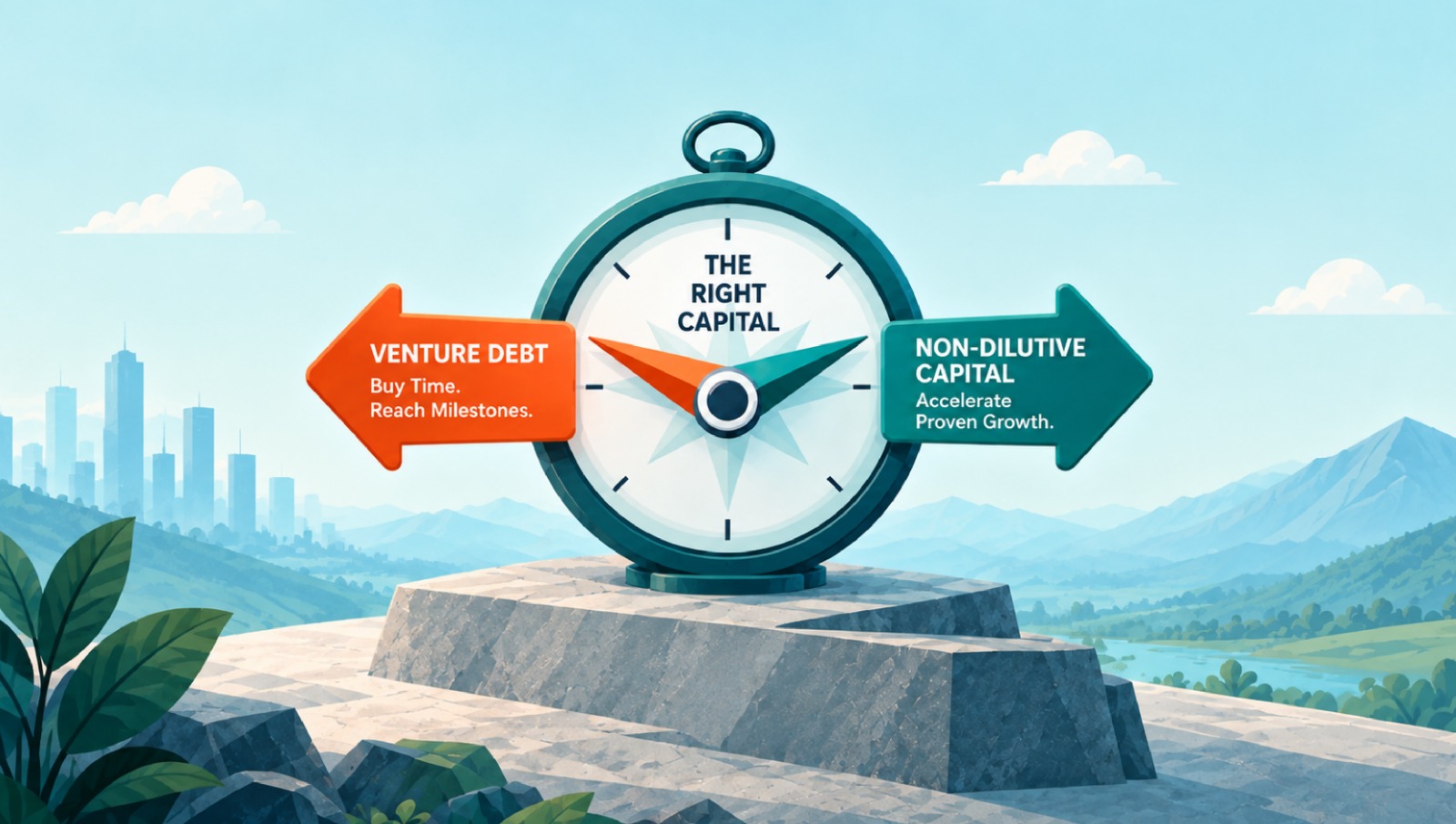
Our CRO Denada Ramnishta puts it plainly: equity funds a vision, debt funds the execution. Different instruments for different jobs. Equity is for bets that define a company's direction. Debt is for the work that follows once that direction is set.
For many modern startups, particularly those in the AI or data-heavy SaaS space, compute costs act as a hidden tax on growth. Early on, these costs are unpredictable and belong in the "Vision" bucket, funded by equity while you figure out your model's efficiency.
However, once you have a baseline of revenue and a predictable cloud or GPU bill, these become classic execution expenses. A Series A startup working on AI, spending $80K a month on GPU infrastructure, is effectively giving away equity to pay a cloud bill.
That is exactly the kind of predictable, recurring cost that non-dilutive capital was built for. Using it to fund such infrastructure costs allows you to preserve your equity for the breakthroughs that actually increase your company's value.
A mistake in timing is often as costly as a mistake in instrument. Most founders only explore debt when the runway is shrinking. At that point, terms are worse and leverage is gone. The founders who use debt well bring it in from a position of strength, ideally right after an equity round, when the business has traction and room to negotiate.
Inkle, a financial operations platform for VC-backed startups, did exactly that. Rather than raising another equity round to capitalise on predictable seasonal demand, they worked with ECL to access non-dilutive capital in tranches aligned to their revenue cycles. The result: two dilution rounds avoided, 90% founder equity retained, and over 500 companies served, all without losing board control.
Ultimately, non-dilutive capital provides speed and flexibility without the "ownership tax." Funds can reach an account within days and there are no board seats or warrants attached. For a founder moving on a specific opportunity — a market expansion or a key hire — that combination is a competitive advantage many don't fully realize until they've used it.
Three Signs You're Ready for Non-Dilutive Capital
Not every stage is the right stage. Generally, non-dilutive capital makes the most sense when you meet these three criteria:
Your MRR or ARR is predictable and growing. Debt gets underwritten against future cash flows. Consistent, recurring revenue is what makes non-dilutive capital accessible and affordable. If your NRR is above 100% and churn is under control, you have something a lender can work with.
You're post-PMF with specific execution needs. A new market, a key hire, a product expansion. These are execution bets, not vision bets. This is exactly what debt is built for. Using equity here means paying the highest price for something that didn't require it.
Your debt stays under 33% of annual revenue. This is the rule of thumb that keeps debt healthy rather than dangerous. A company at $5M ARR should keep total debt exposure under $1.65M. Beyond that, the repayment pressure starts competing with the growth it was meant to fund.
Using equity to solve an execution need is like eating when you're just thirsty. It technically addresses the discomfort, but it's the wrong fuel for the problem. The result is over-reliance on your most expensive capital and leaving more efficient options unused. We talk all about when to raise capital, and when not to, in our blog post. Check it out.
-02.avif)
What Good Capital Management Actually Looks Like
In long races, what matters is how well you manage your energy across the distance. Experienced runners track their heart rate and effort so they can adjust before things go wrong. The same applies to capital.
What we consistently see at ECL is that founders who manage capital well make that decision before the round closes, not after. They know what the money is for and what the right mix of equity and debt looks like for the next 18 months. Without that clarity, many founders only realize they are off pace when they are already running out of runway.
Pro-Tip: Don't wait for your runway to hit 6 months to look for debt. The best time to secure a line of credit is 30 days after you close a venture round. Your balance sheet is strongest, your valuation is fresh, and you have the most leverage to negotiate terms that protect your equity in the long run.
Here's a tool to help you calculate your burn multiple and give you a tip in case you are overpacing.
The Founder's Mile-Marker Checklist
When should a founder use equity vs non-dilutive capital?
Use equity when you are making a bet that defines the company's direction — a new product category, an unproven market, a foundational hire. These are high-risk, high-upside moves where the cost of capital matters less than the optionality it buys. A founder deciding whether to build an enterprise product line from scratch is making a vision bet. That belongs in the equity bucket.
Use non-dilutive capital when the path is already proven and you need to execute on it. Predictable revenue, a specific use case, a defined outcome. If you can model the return on the capital before you deploy it, debt is almost always the cheaper instrument. A founder who has closed 15 enterprise accounts and needs to hire two more account executives to service them already knows the return. That is an execution bet, and equity is the wrong tool for it.
A simple rule of thumb: if the decision requires conviction, use equity. If it requires execution, consider debt first.
-03.avif)
Run Smart, Not Just Fast
The founders who build the most capital-efficient companies are not the ones who avoid debt. They are the ones who stopped treating equity as the default answer to every capital question. That shift in thinking is not complicated. It is just uncomfortable because it requires admitting that the way most of the startup ecosystem talks about funding is incomplete.
The race is long. The founders who finish strong are the ones who figured that out early enough to do something about it.
At ECL, we work with SaaS and AI founders across the US, India, and Singapore to help them access non-dilutive capital at the right stage, so they're not relying on their most expensive capital for every stretch of the journey. Talk to us today!

.jpeg)
Founders who drive the future deserve capital that accelerates with them. Let’s make this the most efficient chapter of your story.