
How Much Debt Is Too Much? A SaaS Founder's Guide to Healthy Debt
2 mins
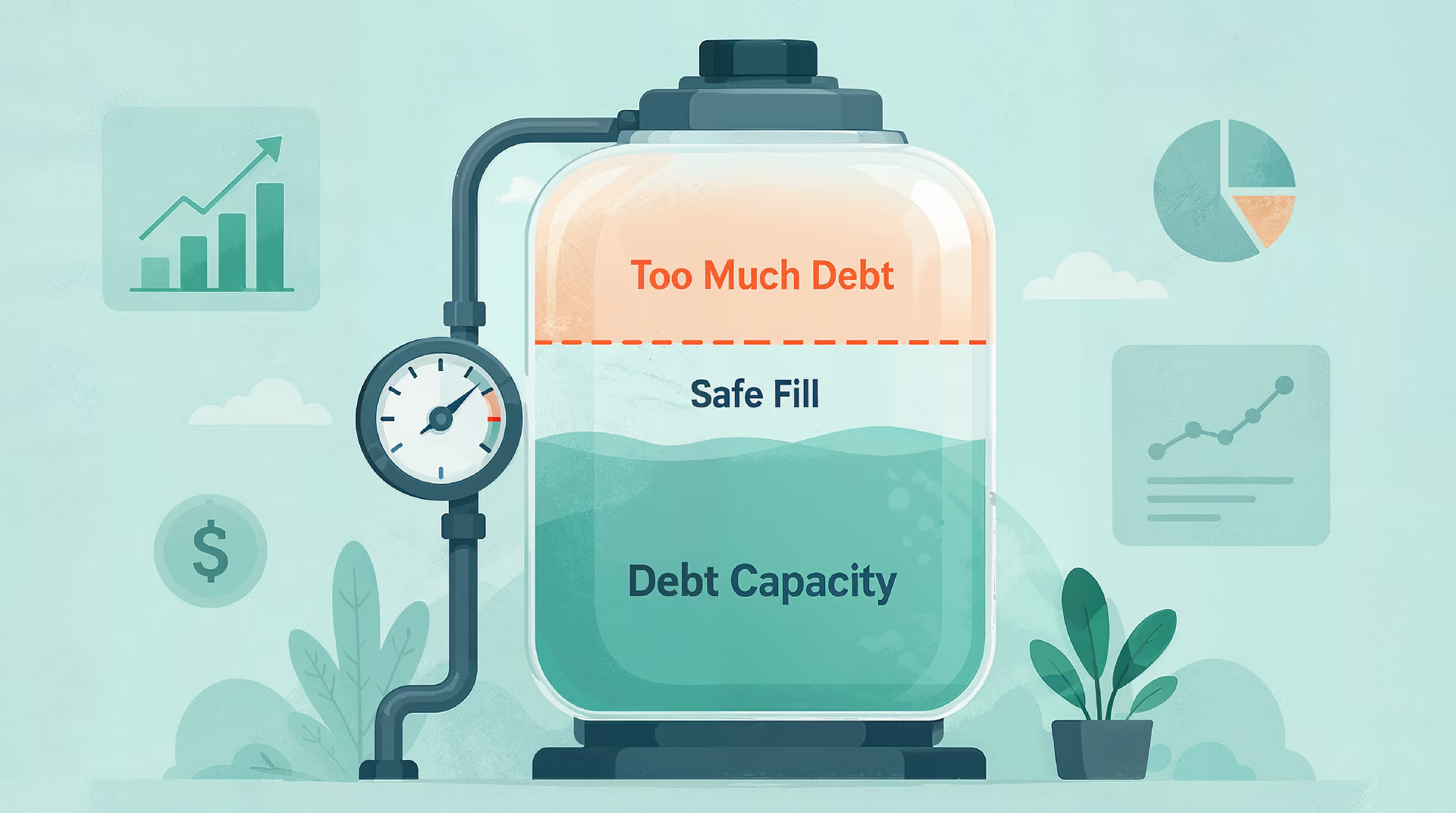
TL;DR: Debt can be a powerful growth tool for SaaS and AI companies, but only when it's tied to a proven return. The amount of debt that's “too much” depends less on a startup's balance sheet and more on its ability to service that debt if growth slows. Before taking on capital, founders should understand how debt compares to ARR, burn, and runway — not just how much money they can borrow.
Debt has become a common growth vehicle for startup founders. The expansion of non-dilutive capital options has given SaaS and AI founders greater resources for extending runway, accelerating growth initiatives, and holding off on raising a round before they're really ready.
But with more options comes the need for a more nuanced approach to evaluating debt and determining how much capital the business can reasonably support.
Unlike traditional businesses, software companies often combine high gross margins with recurring revenue and asset-light operating models. AI companies face additional considerations, including substantial investments in compute resources, infrastructure, and technical expertise. As a result, traditional debt metrics don't always tell founders what they need to know.
Here are some sound pointers for how to assess your capacity for debt, determine your capital deployment strategy, and make sure your business is attractive for lenders and investors.
There Is No Universal Debt Limit
While there are some useful industry benchmarks that can help you with context…
- To avoid repayment strain, serviceable debt should be less than 25% of your monthly revenue.
- Generally speaking, the lower your gross margin, the lower your debt ceiling should be.
- Lenders typically look for companies with 6-18 months of runway in place before the debt facility is added.
…there is no simple rule of thumb to follow. These benchmarks shouldn't be treated as targets — here's why:
Two companies with identical ARR can have dramatically different debt capacity depending on their growth efficiency, customer retention, and cash burn.
What matters most is whether the capital is being deployed against a predictable return.
Debt Works Best When Funding Proven Returns
The healthiest debt stories tend to share a common characteristic: The company already knows where the return will come from.
Let's look at a few real-world case studies:
Scenario 1: Debt as a Lever to Accelerate Proven Growth Opportunities
At $8 million ARR and 40% YOY growth, Company A faced a choice between giving up some equity for a Series B or pursuing non-dilutive capital.
Leadership had identified a clear opportunity: Their product-led acquisition converted customers at roughly 3x the rate of their outbound sales motion.
Instead of funding broad experimentation, Company A borrowed $2.5 million to improve onboarding infrastructure and launch a self-service offering to further their product-led acquisition efforts.
Eighteen months later, ARR had reached $15 million, gross margins were higher, and the original loan was repaid — without diluting equity. The company later secured additional funding from a much stronger position.
The lesson here: Yes, the debt drove growth, but it also directly funded a proven return model. There was no uncertainty about how the debt would be repaid.
Scenario 2: Assumption-Based Debt Is Risky Debt
Company B approached lenders with roughly $4 million ARR, solid retention metrics, and several large enterprise opportunities in its pipeline. At first glance, the business looked like a strong funding candidate.
A closer review revealed concerns: Customer acquisition payback exceeded 20 months, revenue forecasts depended heavily on a handful of large deals, and leadership hadn't modeled what repayment would look like if those opportunities slipped.
After rejecting a more conservative funding proposal, Company B secured multiple loans elsewhere and used the proceeds to expand headcount and increase marketing spend.
Unfortunately, those anticipated enterprise deals never closed. As repayment obligations mounted, Company B's leaders were under intense pressure. Product development slowed, churn increased, and management spent more time solving financing problems than building the business.
Company B ultimately survived — but only after a painful restructuring and highly dilutive financing event. Funding assumptions instead of validated growth proved to be an expensive mistake, and a setback that could have possibly been avoided.
Predictable Returns = Stronger Outcomes
With all the press around huge funding rounds in recent years, there's a tendency among many founders to treat capital like a vanity metric. As you explore funding options, remember: Debt is a growth engine. Your capital stack is part of your ongoing financial architecture — you want it to propel you forward, not hold you back.
4 Metrics to Determine How Much Debt You Should Take On
The following indicators will help you evaluate your debt capacity, and your attractiveness to lenders:
1. Debt-to-ARR
In SaaS, annual recurring revenue (ARR) is a better measure of debt capacity than traditional assets.
A company with $10 million ARR and $2 million in debt is in a very different position than a company with $4 million ARR carrying the same obligation. As debt begins to approach ARR, you'll want to take a harder look at repayment risk and downside scenarios.
2. Burn Multiple
Debt amplifies whatever already exists in the business.
If your company is efficiently converting cash into growth, debt can accelerate progress. But if you're burning aggressively without producing proportional revenue growth, debt simply magnifies the problem.
Before taking on capital, be realistic about whether your growth engine is truly efficient or merely expensive.
3. Debt Service as a Percentage of Burn
Debt service should generally remain below 25% of your net burn.
Once repayment obligations begin consuming a significant portion of your available cash, you lose flexibility. Growth investments become harder to make, and your attention shifts from scaling the business to managing liabilities.
4. Runway Under a Stress Scenario
Many founders model debt assuming everything goes according to plan. If you've been in the startup world long enough, you know that surprises are inevitable.
Pressure-testing is a better approach. Run a few scenarios in your forecast tool to see what the impact would be if growth slows by 20%, a major deal slips next quarter, or churn unexpectedly rises. If you would struggle to repay under those conditions, your debt facility may be too large — or simply premature.
Are You Ready to Take on Debt? Answer These 3 Questions
You undoubtedly want a success story like the first case study we shared above. It's possible, as long as you treat debt as a component of your financial strategy rather than a windfall or stopgap.
Before taking on any debt facility, ask yourself these questions — and be honest with yourself about the answers:
1. Do I know exactly what this capital will fund?
Your answer should be specific. Hiring, infrastructure, customer acquisition, or product expansion are all valid ways to leverage debt. “General growth” is not.
2. Do I have data showing the return on that investment?
Debt is most effective when it funds proven growth levers. If the initiative you want to invest in is still experimental, equity financing may be better suited to absorb the risk.
3. Can my current ARR support repayment if growth slows by 20%?
Every repayment model should be stress-tested. If a modest slowdown creates significant financial strain, your org may not be ready for additional financing.
Debt Should Create Options, Not Pressure
For SaaS and AI companies, debt isn't inherently risky. Deployed smartly, debt is a lever that helps you accelerate growth, extend runway, and position yourself to negotiate from a position of strength for that next equity event.
Debt should increase your options, not your pressure. Taking the time to understand your unit economics, identify a proven return on investment, and know how to comfortably service repayments under less-than-ideal conditions makes you much more attractive to lenders and investors — and helps you magnify your strengths instead of increasing risk.
The right question is never how much capital you can raise, but how much you can reasonably support.
P.S. Efficient Capital Labs helps SaaS and AI founders grow without diluting equity. Explore your options here.

Related posts
.jpeg)
The Invitation
Founders who drive the future deserve capital that accelerates with them. Let’s make this the most efficient chapter of your story.