
Non-Dilutive Financing Fees Explained: True Cost, Hidden Charges and How to Compare Providers

Key Takeaways:
- Non-dilutive financing lets founders access capital without giving up ownership, but headline rates rarely reflect the true cost of funding.
- Hidden costs such as origination fees, warrants, prepayment penalties, and currency conversion charges can significantly increase financing expenses.
- According to Carta, median dilution across seed to Series C funding rounds dropped from approximately 18% in 2024 to 16% in 2025.
- Comparing financing offers requires calculating total repayment, net cash received, warrant value, and annualized cost of capital.
- Efficient Capital Labs (ECL) offers transparent, fixed-fee non-dilutive financing with predictable monthly repayments, no equity dilution, warrants, or personal guarantees.
Two non-dilutive financing offers sit side by side on your screen, with one quoting 8% and the other 11%. Easy decision, right? Not so fast.
Non-dilutive financing keeps your cap table intact, but the headline rate rarely tells the full story. Fees, repayment terms, and hidden charges can make a seemingly cheaper offer more expensive. And the last thing you need is a surprise buried in the fine print.
That's why looking beyond the advertised rate matters.
This guide breaks down pricing structures, hidden fees, and the true cost of capital, helping you compare providers before signing.
What is non-dilutive financing, and how do you pay for it?
Non-dilutive financing allows businesses to raise capital without giving up equity. Most debt-based options require repayment through fees or interest, although some arrangements, such as venture debt, may include warrants that introduce potential equity dilution. Your cap table stays exactly as boring as you left it.
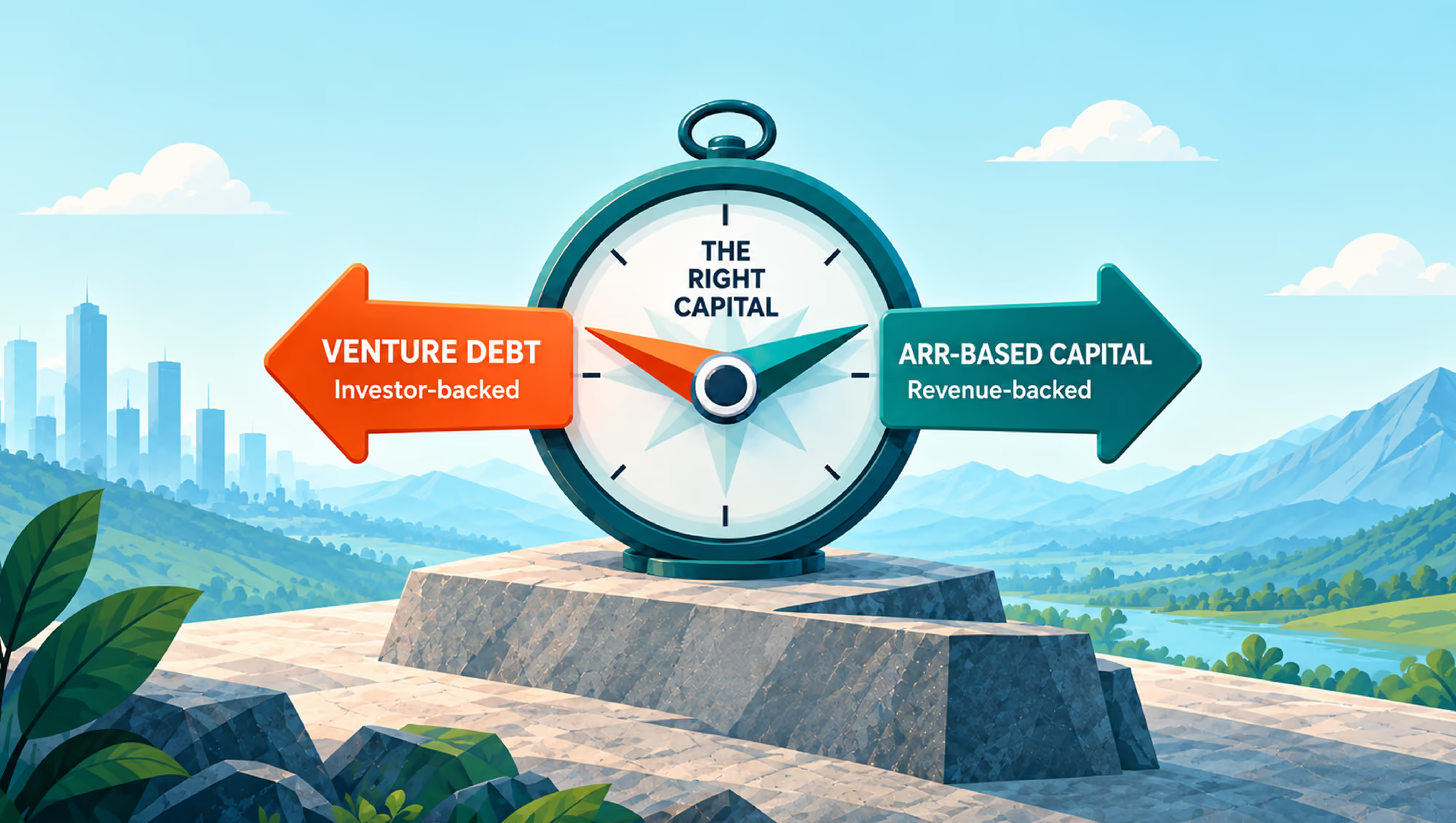
Debt-based non-dilutive financing typically follows a repayment schedule. Common options include ARR-based financing, revenue-based financing, venture debt, and bank term loans. Grants are also non-dilutive but generally don't require repayment.
Understanding the components of financing costs is important before comparing offers, as each financing option prices capital differently.
What fees make up the cost of non-dilutive financing?
Most non-dilutive financing offers combine a core pricing component with one or more additional fees. The total cost depends on how these charges are calculated and when they’re paid.
Here are the four common pricing components you should understand before comparing offers:
1. Annual fee or interest rate
An annual fee or interest rate represents the cost of borrowing capital. It could be applied to the full amount borrowed, whereas interest is typically charged on the outstanding balance. So two offers showing 10% can produce wildly different totals.
2. Flat fees and factor rates
A flat fee is a fixed charge on the amount in advance. A factor rate is a fixed multiple amount you pay back. For example, a factor rate of 1.15 on $500,000 means you repay $575,000.
A flat fee non-dilutive financing structure disclosed upfront is easiest to compare because you know the total cost from day one.
3. Revenue share percentages and repayment caps
Revenue-based structures take a set percentage of your monthly revenue. This is written as a multiple of the amount advanced, such as 1.5 or 2.5x.
4. Origination and processing fees
Origination fees are one-time charges to set up the loan, typically a percentage of the amount you borrow. Processing fees may be added, as well as legal fees to cover administrative costs.
These are some of the fees a provider may disclose on the first page of the term sheet, with several other costs showing up further on.
Are there hidden fees to watch for with non-dilutive financing providers?
Yes. The most common hidden costs in non-dilutive financing are warrants, fees deducted at disbursement, prepayment penalties, commitment fees, currency conversion costs, and covenants or personal guarantees.
Some of these charges affect the amount you receive, while others add repayment obligations or put your ownership at risk. Here are seven costs to look out for before signing.
1. Warrants and other equity components
A warrant gives a lender the right to buy shares at a predetermined price, introducing potential equity dilution. Venture debt agreements may include warrant coverage of 10% to 20% of the loan amount, depending on the lender and financing terms.
2. Fees deducted before the money reaches your account
Some providers take the setup fee out of the advance, so the net amount you receive is smaller than the full amount you need to repay. For example, you’re approved for $1 million with a 2% fee deducted, so you receive $980,000. Your repayment terms are still based on the $1 million. Look for the details in the disbursement terms.
3. Prepayment penalties and fixed totals
A prepayment penalty is a fee for paying off your loan early, usually a percentage of the remaining balance. You’ll end up paying the full fee whenever you pay off the loan under a fixed-total structure anyway. Basically, paying it off early saves you nothing.
4. Unused-line, commitment and minimum-draw fees
You may pay a commitment or unused-line fee for capital that’s approved but not drawn. Minimum draw requirements could push you to take more funding than you need, and pay for cash that ends up sitting idle.
5. FX conversion and cross-border transfer costs
This applies to companies with a US or Singapore entity, and teams or vendors in India. When funds arrive in USD and get spent in INR, currency conversion spreads and transfer fees can add thousands of dollars to your cost of capital. For example, a 1% spread costs $5,000 on every $500,000 converted.
These costs show up in your bank’s exchange rate.
6. Covenants, personal guarantees and default fees
There are several non-cash costs to keep in mind, such as personal guarantees. Signing one means you’re personally liable. There are also late-payment or default fees when you miss a payment, and covenants that set minimums you need to meet, like cash balance or revenue level. Under heavy covenants, a bad quarter can bite the hardest, such as triggering late fees at an otherwise healthy company.
These terms may be found in their own separate sections, whereas a personal guarantee may be in a separate guarantee agreement.
7. Repeat-draw pricing
Terms on future draws are part of the cost of the first, since many companies return for a second or third tranche.
What questions should you ask about hidden financing costs?
Before signing, ask your provider how each charge affects your repayments, the amount you receive, and your future funding options. Use the questions below to check the terms that matter.
Take note of both visible and hidden charges. Once they’re all on the page, you can add them together to see what you’ll pay.
How do you calculate the true cost of non-dilutive financing?
The true cost is everything you pay minus the cash you receive, plus any equity you give up, annualized over the real payment period.
Yes, there’s some math involved, but breaking it down makes comparing offers easier. Follow these five steps to calculate what your financing actually costs:
- Determine the total amount repaid: Add all scheduled payments and any fees paid separately.
- Determine net cash received: Subtract the fees deducted at reimbursement by the amount approved.
- Calculate the total cost of capital: Subtract the net cash received from the total amount repaid.
- Determine warrant value: Multiply the warrant coverage by the expected share price at exit, divided by the strike price, minus one.
- Come up with the annualized cost: Add the total cost of capital and estimated warrant value, then divide by the net cash received. Divide the result by the repayment period in years to estimate the simple annualized cost. For a more accurate effective annual rate, use XIRR to account for the timing of repayments.
This calculation means that the same fee repaid over six months could cost roughly twice as much as the same fee repaid over 12. For a more precise effective annual rate, list each cash flow by date and use the XIRR function.
Here is an example of two $1 million offers, each repaid over 12 months:
Despite the lower headline rate, Offer A is roughly four points above Offer B. Note, that this annualized figure is also the fair basis for the comparison most make at first.
Is non-dilutive financing cheaper than equity once every fee is counted?
Yes, especially for a company that keeps growing.
The cost of equity shows up as ownership being given up when valued at exit, since it has no repayment. Non-dilutive funding, however, has a cash cost that ends at repayment.
Say you need $1 million. If you raise equity at a $10 million post-money valuation, you give up 10% ownership. At a hypothetical $50 million exit, that stake could be worth $5 million. By comparison, Offer B from the example above costs $110,000 and is repaid within a year. However, equity financing doesn't require scheduled repayments, making the right choice dependent on your cash flow, growth plans, and risk tolerance.
For context, Carta's State of Private Markets: 2025 in Review shows that median dilution across funding rounds from seed through Series C fell from approximately 18% in 2024 to 16% in 2025.
When growth stalls, equity investors share the downside and repayments are still due. While equity tends to fund large and uncertain bets, non-dilutive capital is better suited to defined uses that revenue can repay.
If non-dilutive is the right fit, the next step is finding the right provider.
How do you compare non-dilutive financing providers side by side?
Several factors other than cost are important compare, and are ones that don’t show up in the annualized number:
- All-in cost: This is the annualized figure from the five-step calculation and including warrants.
- Transparency: Determine whether you can see the total repayment including fees in the payment schedule.
- Repayment flexibility: Look for features like options to skip or defer a payment and whether paying off a loan actually saves money.
- Eligibility fit: Consider APR threshold, revenue history, and entity location. Criteria can differ by market, which you can find out more in our guide to revenue based financing in India.
- Speed: Make sure the provider can meet your timeline for funding and when it can make a decision.
- Currency of disbursement: Understand what currency you receive and what it would cost to convert it.
- Repeat capital: See whether you can draw more as ARR grows and on what terms.
When choosing the best fit, consider what your priorities are. If you want fast funding to tide you over until the next round, working with a provider that offers faster decisions may be the better call. Or, if you have more of a runway, the lowest rate is worth choosing so you can free up other capital for a key hire or market entry funded down the line.
How does ECL show the full cost of non-dilutive financing before you sign?
Efficient Capital Labs (ECL) prices its non-dilutive financing as a fixed fee with monthly payments that include principal and interest. All of this is disclosed before you sign so you see the total payment upfront.
Here’s how ECL’s non-dilutive capital terms line up against hidden fees we’ve covered:
- Pricing: Around 10% to 12% in annual fees in USD and is based on revenue stability, growth, and risk profile.
- Amount: $100,000 to $5 million, often up to 60% of ARR and disbursed in tranches.
- Equity and control: No equity, warrants, board seats, or personal guarantees.
- Decision process: You’ll receive a decision in about 72 hours through AURA (Agentic Underwriting & Risk Analytics), ECL’s underwriting engine, combined with human review.
Let’s go back to those two offers. A founder who runs all the numbers carefully will make the choice best suited for their company instead of only looking at the headline rate.
See how non-dilutive financing from ECL could help your company before you sign anything.
Frequently asked questions on non-dilutive financing fees
Is non-dilutive financing recorded as debt on the balance sheet?
If it needs to be repaid, yes. Any financing you repay is recorded as a liability. Work with your accountant to make sure you record it properly.
Does taking non-dilutive financing affect the valuation of your next equity round?
Not necessarily unless warrants are involved. Investors consider your outstanding debt balance and the capital needed to reach revenue milestones when evaluating your company.
Can bootstrapped SaaS companies get non-dilutive financing on the same terms as venture-backed ones?
Venture debt lenders typically rely on equity backing. Providers that underwrite on recurring revenue look at ARR, retention, and cash flow, and can fund both on comparable terms.
Which company metrics have the biggest effect on the fee a provider offers?
Revenue quality is what matters most, including ARR size and growth, net revenue retention, customer concentration, gross margin, and runway. The more predictable and diversified your revenue, the more likely you are to qualify for a lower fee.
Can you negotiate the fees on a non-dilutive financing offer?
Warrant coverage, covenants, commitment fees, and prepayment terms are commonly negotiable.



Founders who drive the future deserve capital that accelerates with them. Let’s make this the most efficient chapter of your story.